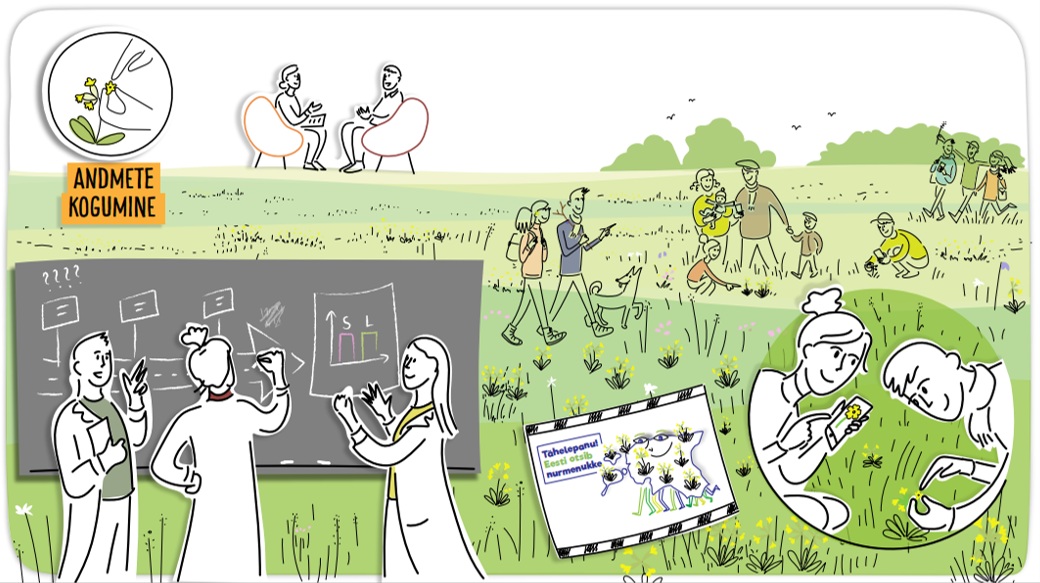
Citizen science – the involvement of volunteers in scientific research – is nothing new. Members of the public have played an important role in observing nature and monitoring environmental change for decades, if not centuries. But can participation in scientific research also help strengthen public trust in science? And what can researchers and research institutions do to ensure that citizen science goes beyond data collection and develops into trustful collaboration?
These questions were the focus of the international symposium Building Knowledge Together: Citizen Science, Communication, and Trust, held on 5–6 October at the Museum für Naturkunde in Berlin. Tsipe, a member of our research group, attended the event together with the Research in Estonia team of the Estonian Research Council and shared communication experiences from a pan-European citizen science campaign.
The symposium explored why meaningful public participation in scientific research remains challenging despite the rapid development of citizen science. How can we reach different groups in society? How can we build and maintain participants’ trust? How can we ensure that collaboration benefits both researchers and volunteers? These challenges are common in many European countries, although citizen science traditions, opportunities and levels of public engagement vary considerably across regions.
Trust in citizen science goes both ways
Discussion about trust between science and society often focuses on whether the public trusts scientists. In citizen science, however, the reverse is equally important: do researchers trust the data and knowledge contributed by volunteers, and do they value their ability to participate in research process? Several presentations at the symposium highlighted that trust is not something researchers can simply “fix” through better science communication. Rather, trust develops through collaboration, where participants have opportunities to ask questions and receive feedback on how their contributions are used to generate new knowledge. For researchers, citizen science therefore requires a willingness not only to share their expertise but also to listen and learn.
Such collaboration, however, takes time, appropriate communication approaches and an understanding of the needs of different groups of participants. International citizen science projects face additional challenges arising from linguistic and socio-cultural differences. Tsipe addressed these challenges in her presentation “Bridging languages and cultures: communication lessons from a pan-European citizen science initiative”, which was based on a recently published research article in the journal People and Nature.
The study examined the experiences of dozens of partners involved in organising the Looking for Cowslips citizen science campaign across 31 European countries. The findings showed that a single communication strategy is not enough to ensure the success of an international campaign. Local traditions, ecological and socio-cultural contexts, and the communication skills and capacities of local co-organizers all need to be taken into account. Engagement approaches that work well in one country may be far less effective in another.
The study also provided a particularly striking example of the importance of sustained communication: when active communication around the campaign declined in 2023, the number of submitted cowslip observations also dropped sharply, even though the observation platform remained open. Thus, simply providing opportunities to participate is not enough: maintaining public engagement requires continuous attention and communication.
Successful citizen science needs institutional support and recognition
Why, then, is citizen science not yet part of the everyday toolkit of more researchers? One important reason is the time it requires. Recruiting, guiding and motivating participants, ensuring data quality, and maintaining ongoing communication and feedback all demand considerable time and resources. Yet this work often receives little recognition in academic career assessments and research funding applications.
Integrating citizen science into scientific research therefore cannot be left to a handful of dedicated enthusiasts. Universities and other research institutions have an important role to play in supporting project design, science communication, data management and quality assurance, ethical considerations and long-term relationships with citizen scientists. The Berlin symposium also explored the responsibility of research institutions in supporting citizen science and strengthening public trust. One practical example is the University of Tübingen’s Public Engagement Hub, which aims to foster dialogue between researchers and society and integrate public engagement more systematically into university activities. Such supporting communication infrastructures help create conditions in which citizen science and other collaborative research approaches are not dependent solely on individual initiatives. The Tübingen example could also serve as a valuable source of inspiration for research institutions in Estonia.
Tsipe Aavik / tsipe.aavik@ut.ee / +372 516 1187


