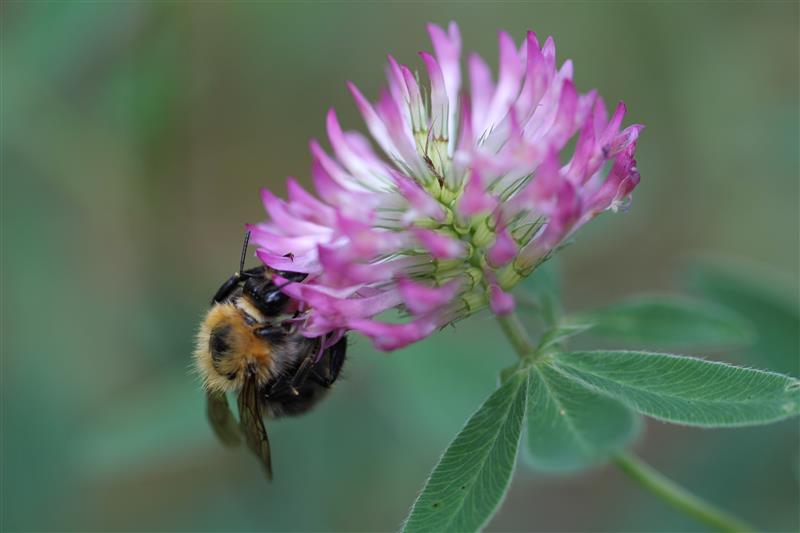
Researchers from the Pollination Ecology Workgroup have recently co-authored two scientific articles on biodiversity in agricultural landscapes. One focused on the factors influencing the diversity of weeds in crop fields, while the other examined the diversity of bumblebees in clover fields.
The study, led by Research Fellow of Entomology Virve Sõber and co-authored by the head of the workgroup, Associate Professor in Macroecology Tsipe Aavik, and Research Fellow in Pollination Ecology Mari-Liis Viljur, showed that clover fields serve as an important food source for almost all bumblebee species found in Estonia – 20 out of 21 species. The most frequently observed species was the white-tailed bumblebee (Bombus lucorum). The discovery of so many species indicates that cultivating red clover in our agricultural landscapes significantly supports all of our bumblebee species. This is important because agricultural areas are often poor in natural forage plants, whereas red clover offers nectar-rich flowers with a suitable shape and a long flowering period.
Bumblebees were found both at the edges and in the central parts of the clover fields, and their abundance did not depend on the size of the field or the characteristics of the surrounding landscape. “Before the study, we assumed that fewer bumblebees would be found in transects located in the middle of larger clover fields, expecting that bumblebees flying in from adjacent meadows and other suitable habitats might not often reach the central areas. However, the results showed that even in the middle of larger clover fields, bumblebees were almost as abundant as near the edges. This suggests that our moderately sized clover fields are evenly “covered” with pollination services, which is important for seed clover cultivation,” reflected the lead author of the article, Virve Sõber.
The second study, focusing on weeds, was partly based on Tsipe Aavik’s doctoral dissertation defended in 2009, during which data were collected on the diversity of weeds in winter cereal fields. The article, led by Spanish colleagues and co-authored by researchers from nine European regions, examined not only the species diversity of weeds but also beta diversity – that is, variation in species composition across fields managed by different farmers.
The study confirmed a previously observed negative relationship between weed diversity and farming intensity: the more pesticides and mineral fertilisers are used in field management, the lower the diversity of plant species found in the field. “In addition, we found that in terms of species composition, weed communities in intensively managed fields do not differ significantly from those in less intensively managed fields. Intensive land use, however, eliminates more sensitive species, leaving only the hardiest and most resilient ones. The study also showed that the within-field diversity of weed flora is shaped primarily by field management intensity. The structure of the surrounding landscape, which was also examined, did not affect weed diversity,” explains Associate Professor Aavik.
Tsipe Aavik / tsipe.aavik@ut.ee / +372 516 1187