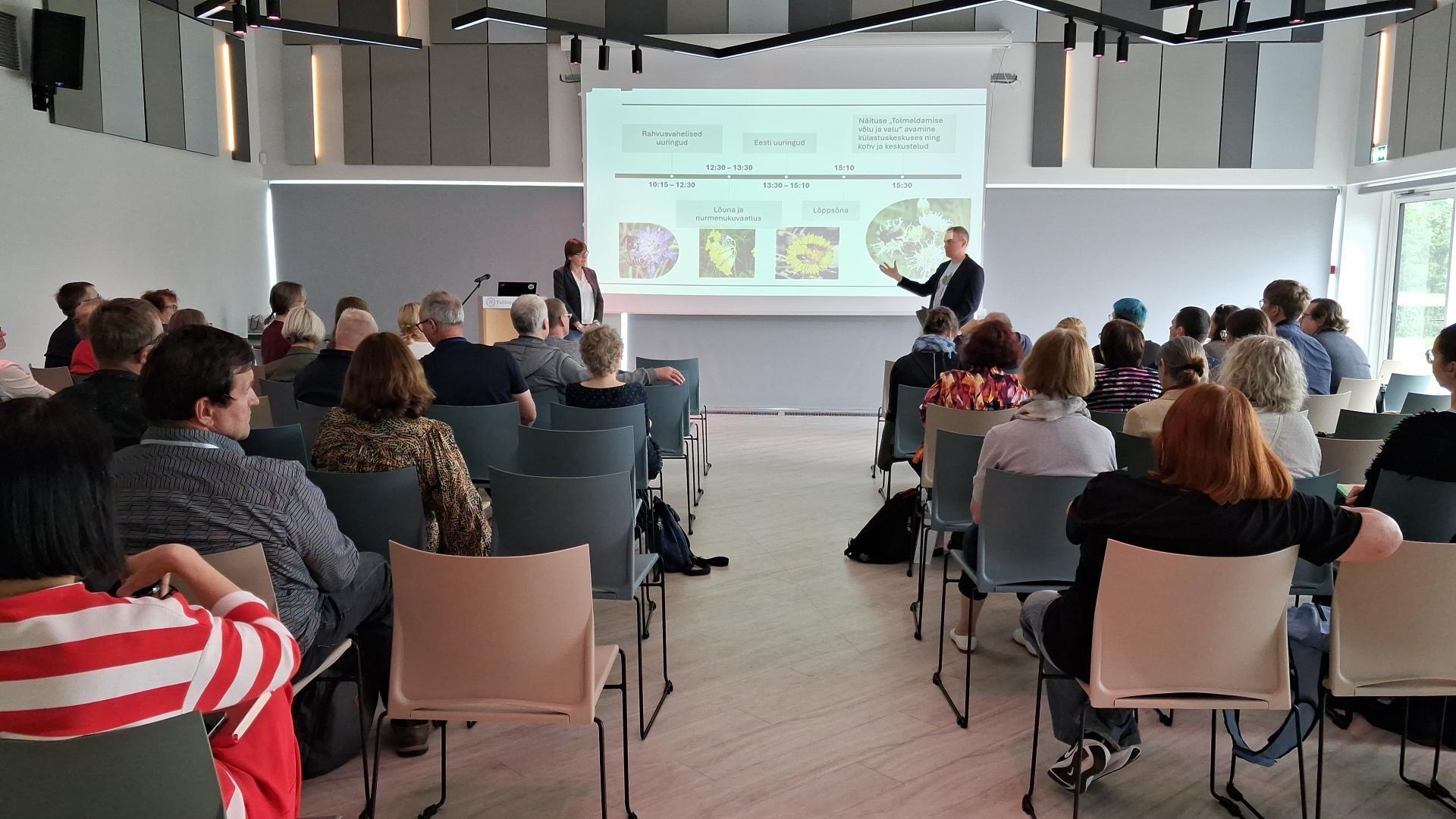
With the arrival of summer, it is easy to notice the bustling activity of insects flowering plants in meadows, forests, gardens, or at field edges. In addition to collecting nectar and pollen, these insects also help pollinate the plants. Approximately 80% of flowering plants rely on the activity of pollinating insects to ensure reproduction—an important aspect highlighted at the conference “Plants and Pollinators – Who Could Separate Them?”, which was organized by the Pollination Ecology Workgroup and took place in Tallinn Botanical Garden in the end of May.
The conference covered topics on pollinators and insect-pollinated plants as well as their interactions. The presentations, aimed at Estonian-speaking audience, were delivered by scientists and practitioners from the University of Tartu, the Estonian University of Life Sciences, the Centre of Estonian Rural Research and Knowledge, and the Tallinn Environment and Municipal Department.
The first part focused on various international research projects in which Estonian scientists participate. The University of Tartu-led Biodiversa+ program project FuncNet, which includes research groups from Belgium, Germany, the Czech Republic, and Sweden, aims to integrate different levels of biodiversity—from genetic diversity to plant–pollinator communities and land-user networks—to understand the complexity of plant–pollinator relationships. Another project within the same program, InterRest, extends this approach by studying the relationships between plants and soil fungi. “Since our research focuses on grassland ecosystems—whose survival depends on human activity such as mowing and grazing—it’s encouraging to see that both scientists and funding policies increasingly recognize the role of land users in understanding and maintaining biodiversity,” noted Associate Professors Tsipe Aavik and Triin Reitalu.
Researchers from the Estonian University of Life Sciences, including Professor Marika Mänd and Associate Professor Reet Karise, participate in Horizon projects PoshBee, SafeGuard, and WildPosh, which explore how various pollinator groups respond to environmental stressors. Laboratory, semi-field, and field experiments reveal that our current understanding of the effects of pesticide on bees has been very limited. Results from PoshBee clearly show that honeybees, bumblebees and solitary bees respond differently to pesticides—differences that conventional risk assessments fail to capture. Moreover, the interaction of multiple pesticides can produce entirely different effects compared to a single pesticide. These effects can be synergistic (mutually reinforcing) or antagonistic. In other words, in this case, 1 + 1 might not equal 2, but rather 3.
One conference session focused specifically on studies conducted in Estonia. This included overviews of two major monitoring projects: a butterfly survey ongoing for around 20 years and a bumblebee monitoring program now in its fifth summer. Although the grassland butterfly index—one of the EU’s key biodiversity indicators—has not shown a downward trend in Estonia, certain butterfly species are still in decline. For example, species adapted to dry meadows have become increasingly rare, such as the dusky meadow brown (Hyponephele lycaon), which has been spotted only infrequently in recent years. “According to a recent follow-up survey, the protected areas in western Estonia that I first studied over 15 years ago for my PhD have lost a significant number of butterfly species,” noted entomologist Anu Tiitsaar. Pollination ecologist Virve Sõber added that bumblebees are more abundant in areas with adequate feeding and nesting sites. Initial bumblebee monitoring results also show that pollinators are less common at field edges in the middle of cultivated fields than at forest edges or within meadow habitats.
Although many of the discussed pollinator studies were conducted in western Estonia, a presentation by Meelis Uustal, head of the Environmental Protection Department at the Tallinn Municipality, emphasized that city dwellers should also keep their eyes open and minds curious. Tallinn features a mosaic of habitats—beyond its typical urban landscape, it also includes bogs, meadows and forests. Even seemingly unimportant wastelands can support nectar-rich plants, offering invaluable food sources for pollinators. Thanks to this habitat heterogeneity, more than half of Estonia’s butterfly and bumblebee species can be found in Tallinn. The city could even lay claim to being the moth capital of Estonia, if such a title existed. “Still, the outlook for pollinators in Tallinn isn’t entirely rosy,” said Uustal. “To maintain favourable conditions, we strive to preserve and restore pollinator-friendly meadow habitats, apply biodiversity-friendly mowing practices and strictly limit pesticide use.”
Two presentations on European citizen science projects showed that gaining better insight into the fate of pollinators and plants is not just the domain of professional scientists. University of Tartu researcher Iris Reinula spoke about the Looking for Cowslips project, conducted in 30 countries, which revealed unexpected changes in floral traits linked to pollination. Reet Karise invited to participate in the recently launched Better-B project, which aims to understand how pollinator feeding grounds are affected by expanding infrastructure, agricultural intensification and biodiversity loss. Everyone is welcome to contribute!
The conference concluded with the opening of the University of Tartu Natural History Museum and Botanical Garden's exhibition “The Charm and Challenge of Pollination,” on display at the Tallinn Botanic Garden Visitor Centre until June 29.
Further information:
Tsipe Aavik, Associate Professor for Macroecology
Tsipe Aavik / tsipe.aavik@ut.ee / +372 516 1187