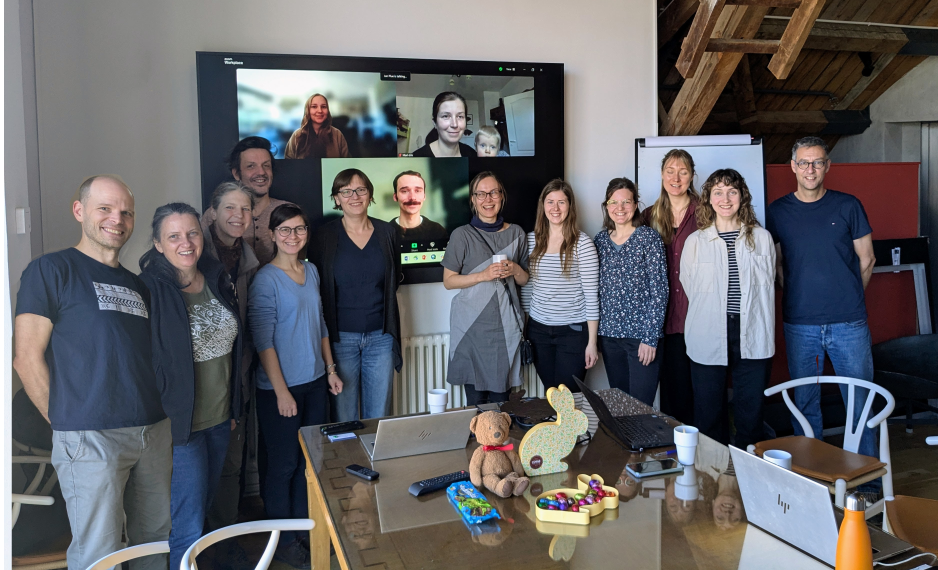
The annual meeting of the FuncNet project took place in Uppsala this time. Although a trip to the Swedish study site was not originally planned, it was nevertheless undertaken, inspired by the wonderful spring weather.
Even though most of the project’s fieldwork has been completed, the life history of cowslips is still being studied in Estonia and the Czech Republic this season. In addition, the German and Czech partners will soon begin interviews with land managers and representatives of other sectors to find out how they relate to the surrounding landscape, what are the main problems and values for managing the landscapes in biodiversity-friendly way.
Several samples collected last year have been analyzed or are being analyzed soon – we are experiencing an exciting Aha! moment seeing the very first results. The preliminary genetic analyses of cowslips suggest that in landscapes with more connected grassland habitats, cowslip populations are genetically more similar to each other, that is genetically more connected. All of this, of course, needs to be analyzed in more depth. The first results of the metabarcoding analysis of pollen collected from pollinators are also expected soon, which will help describe the patterns of relationships between plants and pollinators in different landscapes.
The joint project called FuncNet led by the Pollination Ecology Workgroup of University of Tartu and consisting of researchers from Belgium, the Czech Republic, Germany and Sweden will improve understanding of the spatio-temporal effects of the area and structural connectivity of semi-natural grasslands - the hotspots of European biodiversity - on various aspects of plant-pollinator interactions in European rural landscapes.
More information: Tsipe Aavik, tsipe.aavik@ut.ee


Tsipe Aavik / tsipe.aavik@ut.ee / +372 516 1187